


Digital Marketing

Website Development

Search Engine Optimization

Hotel Distribution Management
OTA Management

Consultation















Imagine someone asks ChatGPT, “What are the top five hotels in New Jersey?” The answer may include several hotels, explain why they are worth considering, and provide links to websites or other sources. But why does ChatGPT recommend those particular businesses instead of others? What information does it use, how does it compare different options, and what can a business do to improve its chances of being discovered in AI search?
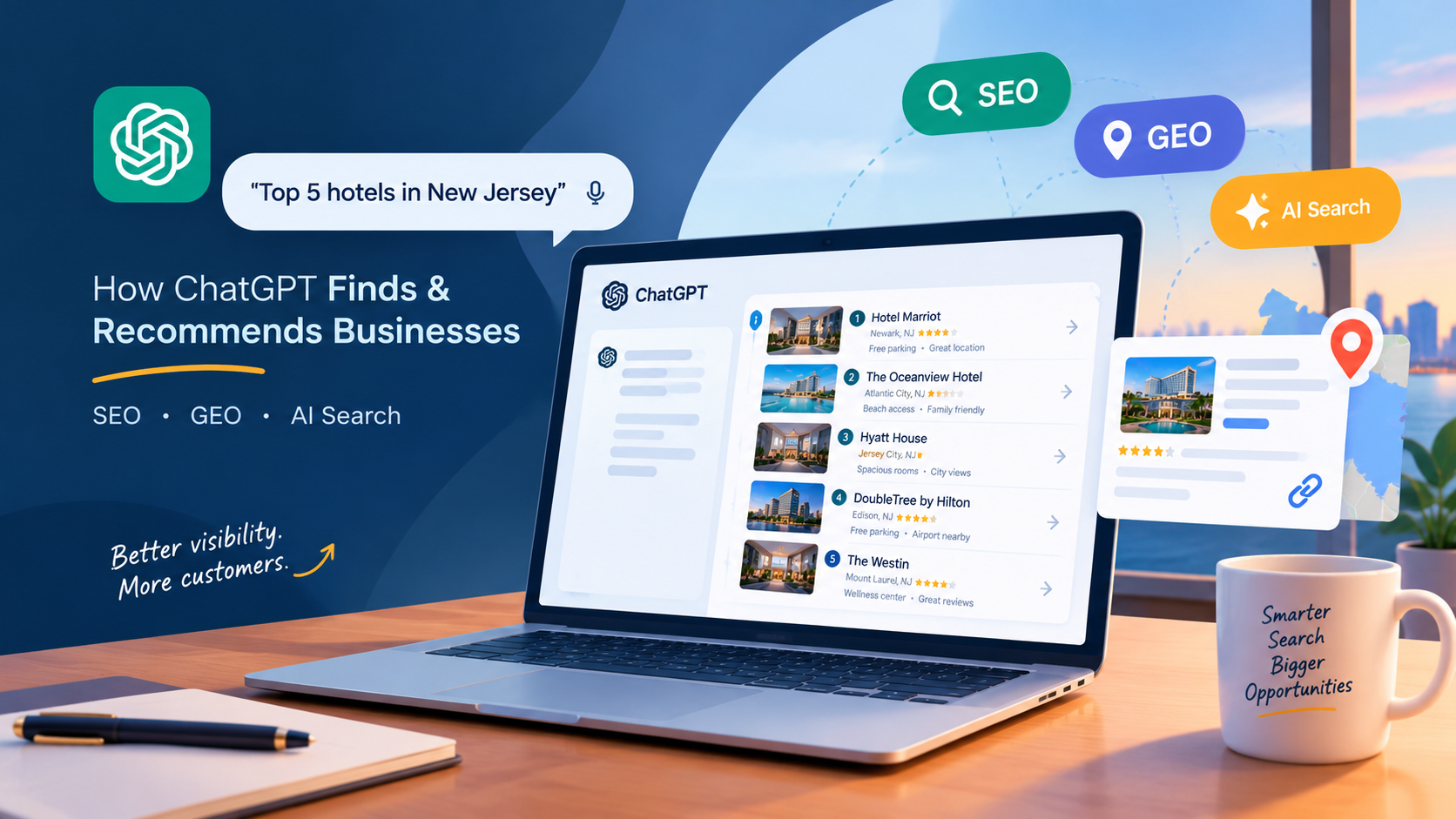
These questions are becoming increasingly important for businesses that want to attract customers through Google and AI-powered search experiences. Traditional SEO focuses on helping websites appear in search results, while Generative Engine Optimization (GEO) focuses on making a business and its information easier for AI-powered search systems to discover, understand, and potentially reference in their answers. The two are closely connected, but they are not exactly the same.
To improve visibility, businesses need to understand how AI search works, what sources may be used, how information can be evaluated, and why technical SEO, website content, reviews, location information, and external mentions all matter. Although no one outside the relevant platforms can provide a complete explanation of every internal ranking mechanism, official documentation and independent research offer useful insights into how businesses can prepare for this changing search environment.
1. How Does ChatGPT Search Work?
ChatGPT can answer questions using its existing knowledge or search the web when current or specific information would help. For example, a general question about hotel amenities may not always require a live search, but a request for the best hotels in a particular location may benefit from current web information. When web search is used, ChatGPT can retrieve relevant information, consider the available sources, and present an answer with links that help users explore the information further.
One important point is that there is no publicly available, fixed ranking formula that guarantees a business will be recommended. OpenAI explains that ChatGPT Search uses multiple factors intended to provide relevant and reliable results, but placement is not guaranteed. The complete internal selection process and the precise weight assigned to individual factors are not publicly documented. Therefore, businesses should avoid assuming that a particular keyword, website change, or optimization technique will automatically make them appear in ChatGPT’s recommendations.
The process can be understood through four simplified stages. First, ChatGPT interprets the user’s request, including the business type, location, and intent. Second, when web search is appropriate, it discovers relevant businesses and information from available sources. Third, it filters and compares the information it can access, considering how well the options fit the user’s requirements. Finally, it presents recommendations or explanations, sometimes with links to supporting sources. This is a simplified way to understand the process, not a complete description of ChatGPT’s internal architecture or every factor used to select search results.
Consider the query, “Share with me the top five hotels in New Jersey.” It contains three main elements: the business type is hotels, the location is New Jersey, USA, and the intent is to receive five recommendations. However, New Jersey is a large area. One person may want to stay near Newark, another may prefer Atlantic City, and someone else may be looking for a hotel near the Jersey Shore. If the user does not specify a city, budget, travel dates, or other requirements, a useful response may include hotels from different areas. If those details are provided, the options can be compared more precisely against the user’s needs.
External resource: Searching the Web with ChatGPT — OpenAI Help Center
2. What Sources Can ChatGPT Use to Find a Business?
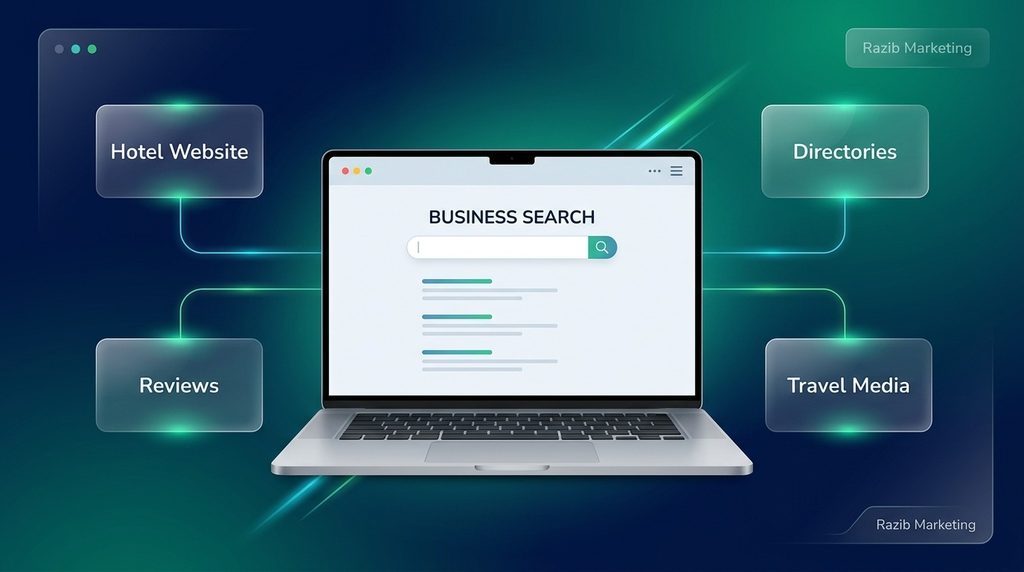
A business’s official website is an important source of information, but it is not necessarily the only source that matters. Depending on the question and the information available, AI search may draw on business websites, review and booking platforms, online directories, editorial publications, travel guides, and other publicly accessible pages that discuss or reference a business. Not every source will be used in every search; the available information and the user’s requirements can affect which sources are relevant.
For a hotel search, the official hotel website can help verify the property’s location, room options, amenities, parking, restaurants, policies, and direct booking information. Review and booking platforms such as Tripadvisor, Booking.com, and Expedia may provide ratings, review volume, recent guest experiences, and other comparative details when that information is available. Travel guides, local publications, and credible hotel roundups can offer additional context about what makes a property notable. Location and local business information can also help establish whether the hotel is close to relevant attractions, transport options, or the area the user wants to visit.
Why look at multiple sources? An independent study by BrightLocal provides an example of how different sources appeared in ChatGPT local-business search results. In research published on December 12, 2024, BrightLocal manually conducted 800 local business searches in ChatGPT and recorded the first ten source links for each search. Its analysis reported that business websites accounted for 58% of the sources, business mentions accounted for 27%, and directories accounted for 15%. The study also examined differences between informational and transactional searches.
These findings suggest that a business’s own website can play an important role, while external mentions and directory listings may also contribute to the information available to AI search systems. However, this was a study of searches conducted at a particular time. Its percentages should not be treated as a current ranking formula or a guarantee that every business category will produce the same results.
For businesses, the practical lesson is to build a clear and trustworthy online presence rather than focusing on a single platform. An official website should accurately explain what the business offers, while relevant directories, booking platforms, reviews, and credible external coverage can provide additional information. The goal is to make it easier for customers and search systems to find consistent, verifiable information about the business across the web.
External resource: BrightLocal — Uncovering ChatGPT Search Sources
3. What Does ChatGPT Look at When Recommending a Business?
There is no publicly documented checklist that guarantees a business will be recommended by ChatGPT. However, when researching AI search visibility, several practical evaluation criteria are worth examining: relevance to the question, location, ratings and reviews, amenities, consistency of business information, reputation, price, availability, and how well the business fits the user’s needs. These are useful areas to investigate, not a confirmed list of OpenAI ranking factors.
Relevance and location are particularly important for local searches. If someone asks for a hotel near a specific attraction, a property in the wrong area may not be a suitable recommendation, regardless of how attractive its website looks. Similarly, a hotel that offers the facilities requested by the user may be more relevant than one that does not. Business information should clearly communicate the property’s location, services, amenities, and intended audience.
Ratings and reviews need to be considered in context. A hotel with a 4.7 rating and 2,000 reviews presents a different evidence profile from a hotel with a 4.9 rating and only 30 reviews. The higher rating alone does not automatically make the second hotel the better option. Review volume, recency, and the substance of recent guest experiences can provide additional context when comparing properties. These are practical evaluation considerations, not confirmed ChatGPT ranking signals.
Amenities and user fit also matter when determining whether an option suits a request. Free parking, a swimming pool, breakfast, Wi-Fi, and pet-friendly policies may be important to some travellers but irrelevant to others. A family looking for a convenient stay may have different requirements from someone travelling for business or seeking a luxury experience. The most useful recommendation depends on how well the available information matches the person’s actual needs.
Trustworthiness and reputation are worth checking across the available sources. If a business’s name, address, phone number, amenities, or other details differ between its website and external listings, it may become harder for people to determine which information is accurate. Reviews and credible third-party references can provide additional context beyond the business’s own claims. Price and availability may also matter when the user supplies travel dates or a budget.
These criteria help explain how a business can be evaluated during a practical search workflow. However, they should not be presented as a complete or official list of ChatGPT’s internal ranking signals. The exact weighting of individual factors remains undisclosed, and no single metric guarantees inclusion in a recommendation.
4. How Are the Final Business Recommendations Selected?
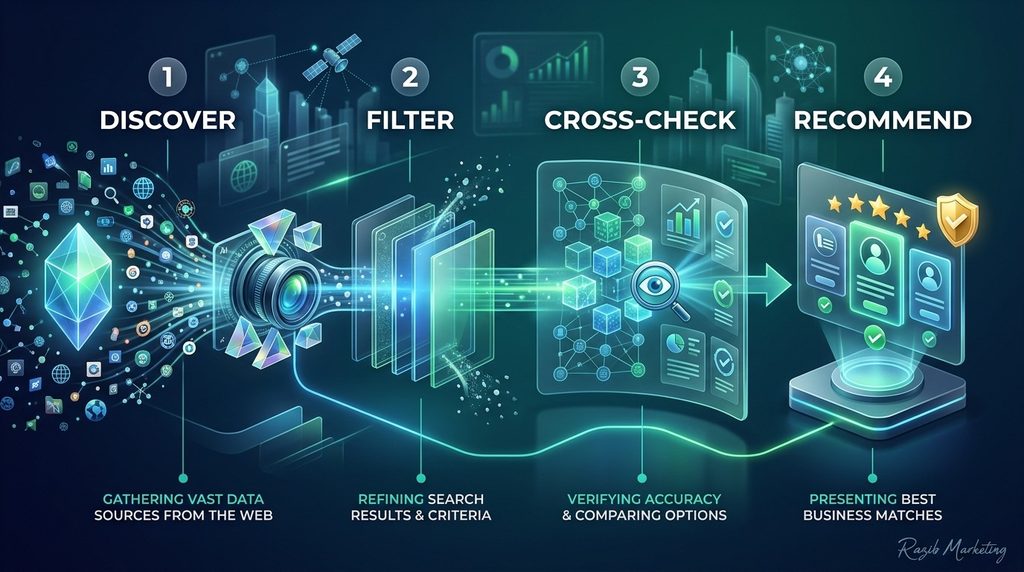
A practical web-search workflow can be understood through four stages: candidate discovery, filtering, cross-checking, and final recommendations. This framework is useful for analysing the process from an SEO and GEO perspective, although it does not reveal every internal operation performed by ChatGPT.
Step 1: Candidate Discovery
The first stage is finding potential options that match the request. For a hotel query, relevant searches may include “hotels in New Jersey,” “best hotels in New Jersey,” searches for specific cities, and relevant review or travel pages. The purpose is to identify potential candidates rather than immediately deciding which businesses are the best.
Step 2: Filtering
The next stage is to remove options that do not fit the user’s requirements. Depending on the information available, this may include hotels in the wrong location, irrelevant properties, closed businesses, or options for which important details cannot be verified. Filtering helps narrow the list to businesses that are more appropriate for the request.
Step 3: Cross-Checking
Information about the remaining candidates can then be compared across relevant sources. The official hotel website may provide the property’s amenities and policies, while reviews, booking platforms, and other sources may provide additional context. Checking these sources can help identify inconsistencies and establish which details are supported by the available evidence.
Step 4: Final Recommendations
The final response can present the options that best fit the user’s request, explain relevant differences, and provide source links when available. A useful recommendation should help the user understand why each option may be suitable rather than simply listing business names.
It is important not to overstate what this process means in practice. ChatGPT does not necessarily open and read every page for every hotel. The number of search results, the pages that can be accessed, and the information retrieved can vary between search sessions. If an important detail cannot be verified, that limitation should be made clear rather than replaced with an unsupported claim.
5. Why Technical SEO Still Matters in AI Search
AI search visibility begins with the basic question of whether a search system can access and understand a website’s content. If important pages cannot be crawled, are blocked from relevant systems, or contain little useful information in the accessible page content, the business may have difficulty making those pages discoverable. Technical SEO remains important because it helps search systems access the website, understand its structure, and identify the information available on each page.
Businesses should review crawlability and indexability, internal linking, page structure, important content, and structured data. Key information should be available in the page’s accessible text rather than relying entirely on elements that may not be processed by every crawler. Internal links should help users and search systems discover important pages, while structured data should accurately describe the content that is actually visible on the page. A technically sound website does not guarantee an AI recommendation, but avoidable technical barriers can limit discoverability.
For ChatGPT Search specifically, OpenAI provides guidance for website owners about allowing its search crawler, OAI-SearchBot, to access their content. If a business wants its website to be eligible for discovery through ChatGPT Search, it should review its robots.txt rules and ensure that its hosting provider or content delivery network is not blocking the relevant crawler traffic. Allowing access does not guarantee that a page will appear in an answer, but blocking access may prevent the crawler from retrieving it.
Google’s AI search features operate through Google’s own systems, so businesses should not assume that ChatGPT and Google use identical processes. Nevertheless, Google’s official guidance emphasizes that established SEO practices remain relevant to its AI Overviews and AI Mode. Websites should remain crawlable, use helpful internal links, provide important information in text, keep structured data consistent with visible content, and maintain accurate business information where applicable.
External resources:
6. GEO: How to Make Your Business Easier to Discover and Understand
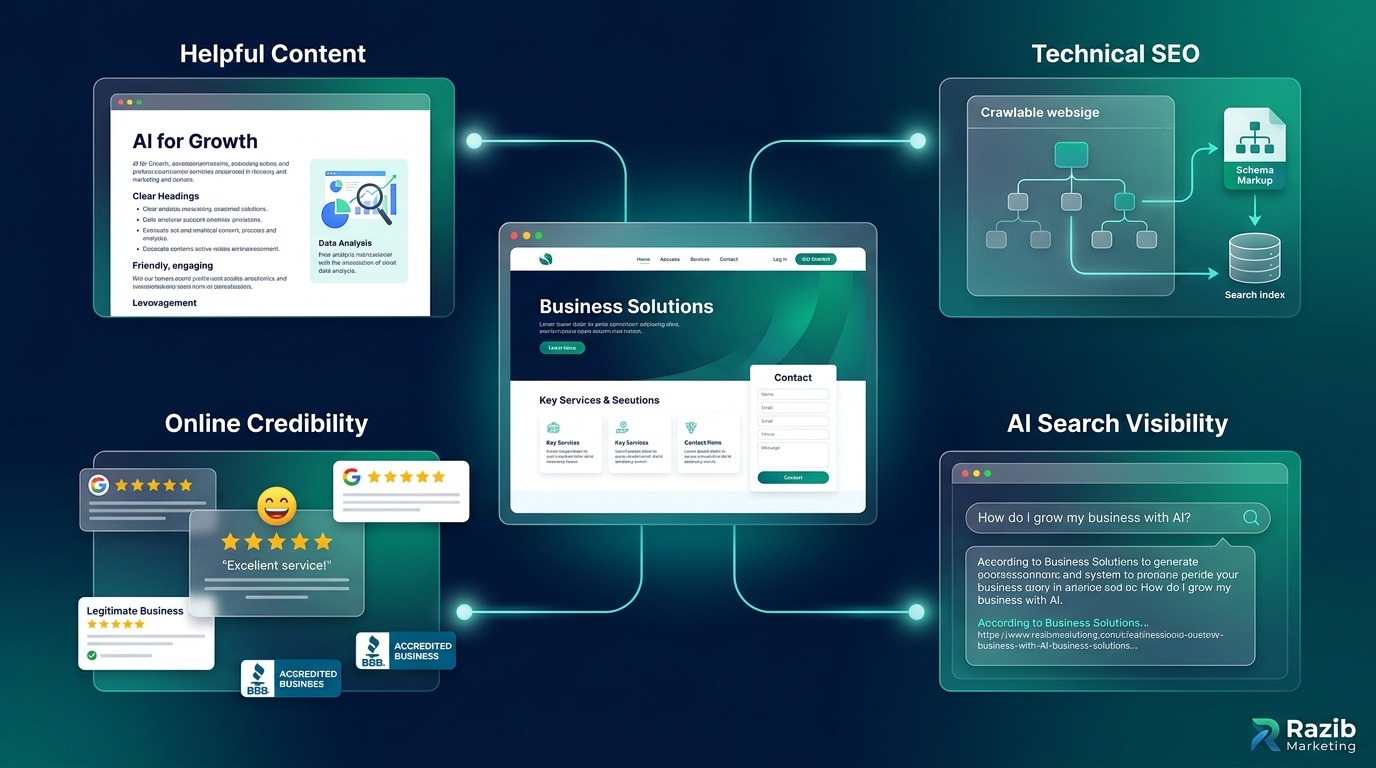
Generative Engine Optimization, or GEO, is an approach to improving how clearly a business and its information can be discovered, understood, and potentially referenced in AI-generated answers. It complements traditional SEO rather than replacing it. Businesses still need accessible websites, useful content, clear page structures, and credible information, but they should also consider whether their content directly answers the questions customers are likely to ask through AI search.
Start by creating useful pages that explain the business in clear language. A hotel website, for example, should make it easy to understand the property’s location, amenities, room options, services, and relevant guest information. Important details should not be hidden behind vague marketing language. When users ask specific questions, clear and accurate content gives them a better understanding of the business and provides search systems with more meaningful information to process.
External credibility is another area worth considering. A business’s website describes its own services, but relevant third-party sources may offer additional context. Accurate directory listings, legitimate reviews, booking-platform information, and relevant editorial coverage can help create a more complete online presence. The priority should be quality and consistency, not generating as many mentions as possible or attempting to manufacture artificial authority. Irrelevant directory listings, inaccurate information, and low-quality paid mentions are not substitutes for credible information about the business.
Content quality matters here as well. Publishing many near-identical pages or using AI to generate large amounts of content without adding meaningful value is not a sustainable strategy. Google warns against scaled content abuse when content is produced primarily to manipulate search rankings rather than help users. A stronger approach is to create genuinely useful pages, answer real customer questions, and make each page meaningfully different when the underlying information warrants it.
Businesses do not need to chase every new AI optimization trend or assume that a particular technical file or markup will automatically increase visibility. Google’s guidance on generative AI content reinforces the importance of useful, original content that serves people. GEO should be treated as a practical extension of sound SEO, content quality, and online reputation management.
External resource: Google Search Central — Using Generative AI Content on Your Website
7. A Practical Hotel SEO and GEO Example
Consider two hotels competing for visibility in the same destination. Hotel A has a technically accessible website with clear information about its location, rooms, amenities, and services. Its important pages are connected through internal links, its structured data matches the visible content, and its business details are consistent across relevant platforms. However, there is limited information about the hotel on credible external sources.
Hotel B also has a good, crawlable website, with clear information about its amenities, rooms, and location. Its details can be checked against information on several review platforms, and relevant travel publications and websites mention the property. If all other factors were equal, the range of available information could make it easier to cross-check details about Hotel B. However, this does not guarantee that ChatGPT will recommend Hotel B first or recommend it at all.
This comparison highlights an important GEO consideration: a business should evaluate not only what appears on its own website but also what relevant, reliable external sources say about it. The goal is not simply to increase brand mentions. Instead, businesses should focus on accurate, verifiable information and credible coverage rather than misleading claims, irrelevant directory listings, or low-quality paid mentions.
For hotel brands with many properties and location-specific pages, SEO and GEO work also require attention to website structure. A single brand may operate hundreds of hotels, while individual properties may have dedicated pages within the same large domain. The goal is to make each property’s information accessible and useful without creating unnecessary duplication or losing important local details.
A practical hotel SEO and GEO audit should examine six areas:
- Property pages: Check whether each hotel page clearly communicates its location, amenities, services, room information, and other relevant details.
- Technical access: Review crawlability, indexability, internal links, accessible content, and relevant structured data.
- Local information: Check that the property’s business details are accurate and consistent across its website and relevant external listings.
- Reputation: Review the available customer feedback and whether the business’s online reputation is represented accurately.
- External coverage: Examine relevant booking platforms, directories, publications, and other sources that mention the property.
- Business outcomes: Connect visibility work to meaningful results, such as relevant website visits, enquiries, bookings, and other conversions where the required data is available.
These areas create a structured way to evaluate a hotel’s online presence without assuming that every recommendation depends on one specific AI ranking factor. They also help identify practical improvements that support both traditional search visibility and the information customers encounter when researching a property.
8. How to Measure AI Search Visibility
AI search visibility can be difficult to measure because responses may vary depending on the wording of a question, the location, the platform, and the time of the test. A business may appear in one response and not another, even when the searches seem similar. For that reason, a single ChatGPT query is not enough to establish whether a business has strong or weak AI visibility.
BrightLocal’s Local AI Visibility Study provides useful context for this challenge. Published in 2026, the study examined 200,085 localized searches and 1.9 million AI citations across ChatGPT, Google AI Mode, and Google AI Overviews. It also tested prompts repeatedly across different locations and over a 60-day period, finding substantial variability. In its ChatGPT findings, the average response included 4.1 businesses, with results ranging from one to seven and a median of four.
These findings reinforce the importance of repeated testing rather than relying on one answer. They do not establish a universal number of businesses that ChatGPT will recommend, nor do they guarantee that a particular business will appear. Instead, they show why AI visibility should be evaluated across a consistent set of relevant questions and conditions.
A practical measurement process can begin with 20–50 questions that reflect the searches customers are likely to make. For a hotel, these might include searches for the best hotels in a destination, hotels with specific amenities, properties near local attractions, or accommodation suited to a particular type of traveller. Record whether the business appears, its position when the response provides an order, and any source links or citations associated with the answer. Also note whether the business information is accurate.
Repeat the tests over time and, where relevant, across different wording, locations, and AI search platforms. Keep the test conditions consistent enough to compare results, while recognizing that not every platform provides the same experience. Connect the findings to business outcomes wherever reliable data is available, rather than treating mentions as a replacement for qualified traffic, enquiries, or bookings.
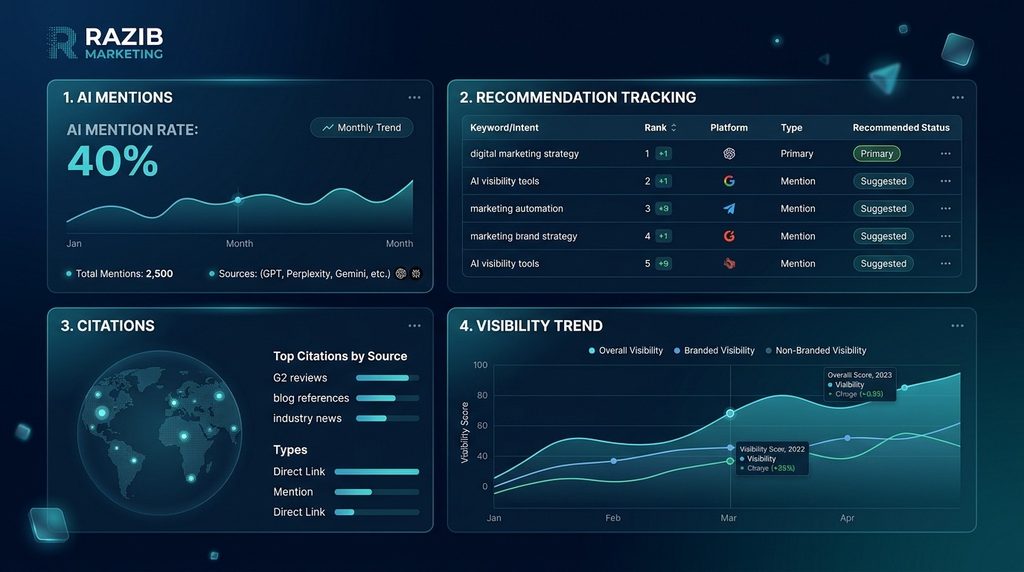
One simple way to summarize the results is to calculate an AI mention rate:
AI mention rate = (Number of test answers that mention the business ÷ Total number of test answers) × 100
For example, if a business appears in 12 out of 30 test answers, its AI mention rate for that specific test set is 40%. This is a custom measurement method for tracking visibility, not an official OpenAI metric or a universal industry standard. It is most useful when the questions and testing method are documented and repeated consistently.
An effective GEO audit should go beyond recording whether a client appears in an AI answer. It should also identify which queries do not mention the client, which sources are cited, what information may be missing or inconsistent, and what evidence supports the proposed improvements. This turns GEO from a set of assumptions into a more evidence-based SEO service.
One distinction is particularly important: a source cited by AI and a source that influenced a recommendation are not necessarily the same thing. Citations help identify which sources were shown to the user, but they do not reveal the complete internal selection process. SEO professionals should therefore analyse cited sources without claiming that every citation directly caused a business to be recommended.
9. What Should Businesses Do to Improve Their Visibility?
Businesses that want to improve their presence across Google and AI search should begin with a clear, practical process. First, make sure the website is technically accessible and that important pages can be discovered. Next, provide accurate and useful information about the business, its services, location, and other details customers need to make decisions. Review internal linking and structured data, ensuring that the information represented in markup matches what users can see on the page.
The next step is to review the business’s broader online presence. Check whether important details are consistent across relevant directories, review platforms, booking websites, and other external sources. Focus on legitimate customer feedback and credible coverage instead of artificial mentions or repetitive content. Each improvement should have a clear purpose: making the business easier to find, helping customers understand what it offers, or improving the reliability of the information available about it.
Finally, measure progress. Use a consistent set of relevant AI search questions, record mentions and citations, and repeat the tests over time. Where possible, connect these observations to website traffic, enquiries, bookings, or other business outcomes. This approach helps businesses make informed decisions instead of changing their SEO strategy based on a single AI answer or an unverified claim about ranking factors.
The central principle is straightforward: make your business easy to discover, easy to understand, and easy to trust. Strong technical SEO, useful content, consistent business information, and a credible online presence provide a practical foundation for visibility as search continues to evolve.
Want to Improve Your Business Visibility in Google and AI Search?
Businesses looking to strengthen their organic search presence need to understand how traditional SEO and AI search visibility work together. From technical SEO and content improvements to local SEO and online visibility audits, identifying practical opportunities can help businesses become easier to discover and understand online.
If you want to evaluate your website’s current SEO performance, identify gaps in your online presence, or understand how your business appears across Google and AI-powered search experiences, explore the relevant SEO services and resources available on the Razib Marketing website.
Do not focus only on where your website ranks today. Build a business that customers can discover, understand, trust, and choose as search continues to change.